

I. Nuance will kill you
Here are several recent trends.
Self-reports of depression and anxiety among teens in North America have been on the rise since roughly the mid 2010s. Self-harm and suicides have also increased, though not by very much in absolute terms. (I did a deep dive into the data on this here for the masochists among you.)
There’s been a steady decline in teens engaging in traditionally “adult” activities, such as driving, drinking, and dating. This is based on several large-scale surveys of American teens from 1976-2016, analyzed by Jean Twenge and Heejung Park here. (Here’s a summary of the paper.)
There’s been an increase in both formal therapy among teens (see here; more detail below), and also in therapy culture more generally, especially in schools. In particular, the presence of “social, emotional, learning” (SEL)—roughly, instruction emphasizing emotional awareness—has dramatically increased in schools.
Most people imagine that (1) causes both (2) and (3). Sad kids are less likely to go out and have fun with their friends, and are more likely to go to therapy.
But here’s an alternative hypothesis: Maybe (3) is actually responsible for (1) and (2). That is, perhaps the increase in therapy is partially responsible for an increase in anxiety and a decrease in adult activity. Maybe therapy is teaching kids to be fragile instead of robust, making them self-conscious and miserable in the process.
The causal mechanism would be something like this:
(i) Too much therapy leads to (ii) More diagnoses, more educational accommodation, and excessive focus on your (now medicalized) “defects,” which leads to (iii) reduced belief in your own agency and avoidance of difficult tasks which leads to (iv) fragility and distress.
This is, to my eye, entirely plausible. We don’t have to go as far as Marc Andreesen to think that too much introspection, especially forced introspection, can be bad for you. Depression is marked by a constant focus on the self, after all. Wisdom from multiple traditions suggests that happiness is easier to find when you’re focusing on something outside yourself—whether an intellectual project or family or community—instead of obsessing over your own ephemeral state of mind. If this kind of relentless self-focus is then coupled with well-meaning but indulgent therapists who don’t expect you to complete your homework unless you’re consistently expressing levels of joy and ecstasy only experienced by gurus on mountain tops or MDMA-addled teenagers at raves, one can easily imagine the adverse effects.
Of course, these things are complicated. Social issues are rarely monocausal, and observational and survey data are notoriously fraught. And there are immediate difficulties that this thesis has to overcome. To take just one: the timing isn’t perfect. Many of the declines in the adult activities of US teens begin before the year 2000, whereas the increase in SEL started in the late 2010s. Plus, even if the timing and numbers all lined up, this thesis has to deal with the albatross of reverse causation: Is an increase in therapy the cause of, or a result of, increased anxiety among teens?
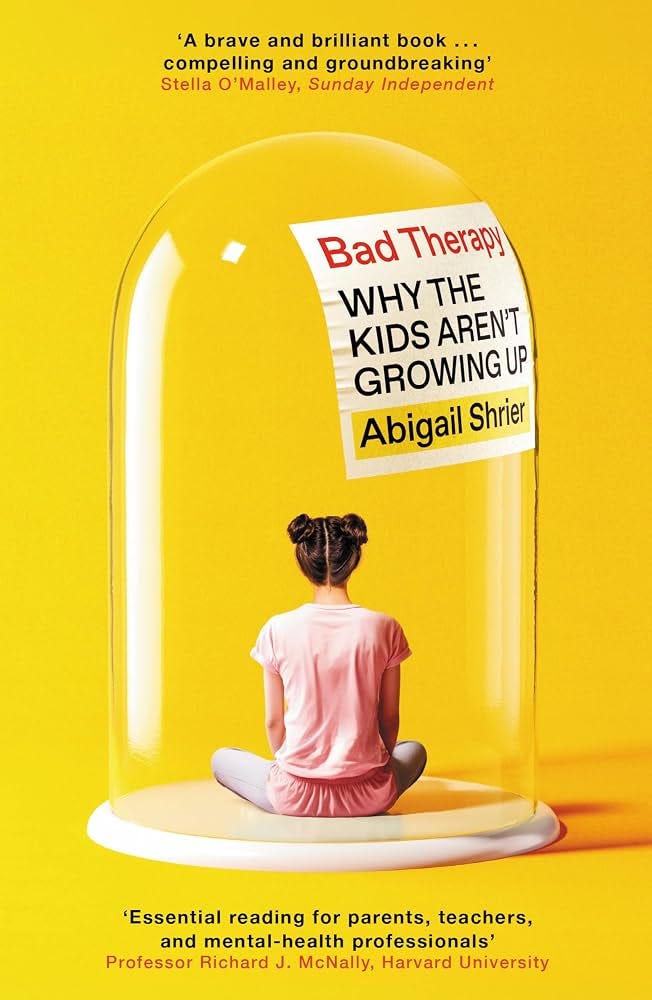
Given both the complexity and stakes of the problem, thank God Abigail Shrier has written a nuanced book examining this thesis. She summons the evidence both for and against, is careful to distinguish between causation and correlation, cites the relevant primary literature, and distinguishes anecdotes from surveys from randomized trials.
Just kidding. Here is how she discusses the problem in the introduction:
[W]e have raised the loneliest, most anxious, depressed, pessimistic, helpless, and fearful generation on record. Why?
How did the first generation to raise kids without spanking produce the first generation to declare they never wanted kids of their own?[5] How did kids raised so gently come to believe that they had experienced debilitating childhood trauma? How did kids who received far more psychotherapy than any previous generation plunge into a bottomless well of despair?[6] The source of their problem is not reducible to Instagram or Snapchat. Bosses and teachers report—and young people agree—that members of the rising generation are utterly underprepared to accomplish basic tasks we expect all adults to dispatch: ask for a raise; show up for work during a period of national political strife; show up for work at all;[7] fulfill obligations they undertake without requiring extensive breaks to attend to their “mental health.”
It’s not unheard of for boys of sixteen or seventeen to put off getting a driver’s license on the grounds that driving is “scary.”[8] Or for college juniors to invite Mom along to their twenty-first birthday celebrations. They are leery of the risks and freedoms that are all but synonymous with growing up.
This is the tone of the entire book. It reads as if Greta Thunberg’s new cause-du-jours, after getting tired of climate change and Gaza, was therapy.
II. Moms.com says your kid is f***ed
I would forgive Shrier her rhetoric if she had built a rock solid empirical case. But she barely makes an empirical case, let alone a good one. To get a sense of the scholarship, look at the references she uses in the last quote.
Despite the generality of the statements, there are no references to any studies or datasets. Three of the four point to news articles (refs [5], [7] and [8]). The claim that young people are “utterly underprepared to accomplish basic tasks” is supported by two articles (ref [7]): a story about Bob Adams, a 73 year old who wants to keep working despite his age (there’s one sentence in the entire piece about young workers), and a half-page article from the BBC that Shropshire Chamber of Commerce is having trouble with interview no-shows and younger recruits not finishing their first week.
The reference in [5] is of an interview with Freya India, an anti-social media activist. If you are patient and follow the references of that interview, you arrive at the Twenge and Park study. Why not just cite that directly?
Meanwhile, she doesn’t provide a reference that we’ve “raised the loneliest, most anxious, depressed, pessimistic, helpless, and fearful generation on record,” nor that gently raised kids have “come to believe that they had experienced debilitating childhood trauma.” But thankfully she provides a reference for the inane statement that some teenagers are scared of driving, citing an article from moms.com for good measure.

Reference [6], which ostensibly supports an alarming claim about kids falling into a bottomless well of despair, doesn’t cite anything. It’s just another paragraph by Shrier discussing the work of Jonathan Haidt. She writes: “In greater numbers than ever recorded, young people writhe in psychic pain and are hitting all the markers of adulthood far later than previous generations,” without a citation in sight.
I find this all rather mind-boggling. Shrier is an Oxford-educated lawyer. In interviews she’s smart, quick, and eloquent. She knows what a well-cited document should look like. She knows how to conduct an actual literature review. Surely she suffered a few pangs of guilt as she wrote in the text “Hospital admissions for non-fatal self-harm were up 62 percent over the previous decade,” and then cited a monologue by Haidt in the Social Dilemma documentary.
To state the obvious: It’s fine to cite news articles and to use anecdotes as evidence. But you can’t pretend you’re doing more than that. You can’t pretend that the data are in, that every scholar agrees that GenZ is more lost than the lost generation, and then secretly build your case around Bob Adams returning to work for the shipping department at his old company so that he can “afford to buy all the toys I want.”
Things don’t get better in the rest of the book. Even when she discusses relevant data, it’s all via secondary sources. In the midst of all the sweeping statements there’s no serious grappling with how we know what she purports to know, whether we should be confident when making causal claims, or whether there are any trends that don’t sit well with her thesis. (For instance: self-reports of depression have also increased in some parts of Europe, but not all parts. Have those parts also seen an increase in therapy culture?)
If you’re already convinced that GenZ is lost and you think talking about your emotions in school is terrible and some sort of symptom of anti-Americanness, you’re going to love it. If you are genuinely curious about some of the trends in this generation and looking for a well-researched exploration of one possible cause, you’re going to need therapy yourself.
Shrier is on the surest empirical footing when describing the increase in teen therapy, though even here she’s less than careful. The best data I can find on this comes from two studies, both with Mark Olfson as first author. The first looks at mental health trends from 1996-2012, and the second at trends between 2019-2021. Combining the results, we see that among American teens aged 6-17, approximately 9.2% visited some sort of “outpatient mental care” in 1998, 11.5% in 2005, 14.0% in 2012, 14.4% in 2019, and 15.3% in 2021. So it has increased, but most of the increase came before 2012. The trend line is even more stable among 6-11 year olds: 9.4% in 1998, 9.6% in 2005, 12.6% in 2012, 9.2% in 2019, and 10.5% in 2021.

Here outpatient mental care is defined “as at least 1 visit with a mental health diagnosis; at least 1 visit with psychotherapy or mental health counseling as the main visit reason; at least 1 visit to a psychiatrist, social worker, psychologist, or mental health counselor; or at least 1 psychotropic medication for a mental health condition.” Is this fair? Shrier focuses mainly on psychotherapy, though she defines this as “conversations about feelings and personal problems styled as medicine,” which seems to fit the outpatient definition above.
Regardless, the first Olfson et al. study has the psychotherapy percentage going from 4.2% in 1996/98 to 6.0% in 2010/12 among 6-17 year olds (there isn’t a further breakdown by age group). The second Olfson et al. study doesn’t look at psychotherapy specifically. There is CDC data on psychotherapy (2019 and 2021), but their definition of psychotherapy is different from the first study. Still, their numbers are indeed higher. They report that 10% of youth aged 5-17 (note slightly different age range) received psychotherapy in 2019, and 11.5% in 2021.
What does Shrier make of these numbers? I don’t know, because she doesn’t discuss them. In fact, she doesn’t cite anything which tracks how the number of teens in therapy has increased or decreased over time.
What she does reference is a 2018 Stress in America APA report, which found that 37% of GenZers have been to some sort of therapist (not necessarily recurringly—it could just be once in their life), compared to 26% of Gen Xers. Seems like a big increase! But Shrier neglects to note that the report also has 35% of Millennials going to therapy. So shouldn’t we see the same effects on Millennials? Crickets.
She also discusses the rise in social emotional learning over time. And here she’s absolutely correct that SEL has dramatically increased since the late 2010s, going from 46% of public schools in 2017-18 to 83% in 2023-24 (RAND report).
Unfortunately, it’s genuinely hard for me to figure out what the precise goals of SEL are, and Shrier is not about to tell me. In the RAND report it’s defined as “the process through which all young people and adults acquire and apply the knowledge, skills, and attitudes to develop healthy identities, manage emotions and achieve personal and collective goals, feel and show empathy for others, establish and maintain supportive relationships, and make responsible and caring decisions.” (See overview of implementation in the report.)
This just sounds like corporate pablum to me, but I’m open to it being harmful. It wouldn’t be the first time that I’ve been against state or federal level teaching goals (such as some California schools getting rid of honors English classes for the sake of “equity”). My mom was an elementary school teacher and would rage at some of their policies, so I’m perfectly capable of believing that educational administrators are doing more harm than good.
But Shrier goes further than I would, and is comfortable blaming SEL for … everything? The Gulag is back, and it takes the form of kids using colorwheels to discuss their emotions.
Here are a few of her examples of SEL in practice:
An elementary school teacher beginning the day with a learning circle, in which kids are asked to say something that made them sad. This apparently resulted in half the class crying and the teacher skipping math class.
Another in which they’re prompted to share something traumatic with the class.
A teacher asking her kids to begin the day by labelling it as either a “bones” or “no bones” day (basically a good or bad day).
Students in a math class were asked to say which shape “didn’t belong.” The answer was no shape, everything belongs!
A worksheet called “I spy” encouraged kids to covertly spy on their family without their knowledge, observing their behavior and inferring their mood/intentions. (Shrier says this might as well be called Hero of the Soviet Union.)
I’m willing to believe these are bad policies. But how prevalent are they? Do the majority of teachers support or implement these methods? I have no idea, and I don’t think Shrier does either. Confusing anecdotes for widespread policies is the book’s favorite empirical method.
III. Pity the thesis
The most annoying part of all of this is that Shrier makes some good points! I think she’s genuinely onto something. She’s just so overconfident and careless when presenting her ideas that you can’t help but be frustrated. The book could have been really good if she was just more honest about the shortcomings of her thesis.
Some of the good stuff:
I liked the idea that constantly focusing on your emotions is a bad idea. The road to happiness is not via paying incessant attention to your own mood. In fact, you might argue that part of becoming an adult is learning to not take your own emotions too seriously; to recognize that they’re fleeting and impermanent, and to learn that long-term fulfillment is based on focusing on things outside your own head.
That kids are engaging in fewer adult activities is a curious trend. I’m not convinced that we can attribute it to SEL in school, and I’m not convinced that it’s all bad. (Maybe fewer kids drive because more kids live in cities, and it’s annoying to own a car in a big city.) But the general phenomenon of arrested development seems real.
The discussion of iatrogenesis (inadvertent harm caused by a medical intervention) in Chapter 1 was masterful. Either something is a serious medical intervention, in which case it’s changing your physiology or psychology in substantial ways, thereby having some risks associated with it, or it’s not a serious intervention. Therapists cannot claim both that they’re having a serious impact on a child’s psychology, and that there are no attendant risks.
The discussion of incentives is also good. The more that therapy is normalized, the more that therapists can choose relatively easy clients over difficult ones. This isn’t to say that all therapists will opt for the easy way out, but it’s silly to ignore the perverse incentives at play.
Her criticism of The Body Keeps the Score was fairly persuasive, and she summons credible expert testimony to call its findings into question. (Though admittedly, I’m now less confident in her criticism because of my reservations about how she handles empirical claims in the rest of the book.)
And I think some of her anecdotes are genuinely disconcerting. She opens the book discussing how, on a visit to the ER because of a stomachache, her son was given a mental health survey which he was asked to complete without her in the room. It asked questions such as “In the past few weeks, have you wished you were dead?”, “In the past few weeks, have you felt that you or your family would be better off if you were dead?,” and “Are you having thoughts of killing yourself right now? If yes, please describe.” (The last one is particularly arresting. Whatever you do, don’t think of an iceberg.)
I’m enough of a libertarian to think that this kind of state intervention is a little much. If you’re in the hospital for something related to self-harm or mental health, then I can understand why these questions have to be asked. But I don’t think we need to be asking every eight year old who scraped their knee if suicide has been on their mind lately. Ditto with some of her SEL examples. I would prefer that my kid’s math class was spent doing math, rather than discussing trauma.
I don’t understand why Shrier couldn’t have written a book that avoided overclaiming and just said: “Look, I think therapy is harming our kids. There’s some evidence on the question, but it’s hard to study and there’s nothing conclusive in either direction. But I’m convinced something bad is going on, so I’m going to present you with the reasons that I think too much therapy is harmful, and with real examples of the kind of culture I’m criticizing. Overall, I want to start a public conversation about this, because I’m really worried about it.”
Maybe a book like that wouldn’t sell. But even so, at some point you have to be an adult (I’m aware of the irony of the charge) and take responsibility for what you’re writing, even if you make one less appearance on Joe Rogan because of it.
Shrier is arguably even doing her own thesis a disservice. The book is so obviously one-sided, so staunch in its hatred of therapists and a certain kind of parent, that it’s going to drive away the exact crowd that she is trying to convince.
The best defense of Shrier I can offer is that she’s highlighting an important possibility that we should take seriously. She’s trying to draw attention to a mechanism that is under-discussed, and she thinks the best way to do it is to write a polemic. This would even be in line with my take that dogmatism can be good for public conversation. But that doesn’t stop me from criticizing the dogmatists.
Thanks to Rich and Cam for feedback. Vaden and I talk about this in an upcoming Increments episode. I think he’s mildly more positive about the book than I am.