

For the past three years I’ve been involved in a book club with two friends. It’s fiction only, a choice we could barely explain to ourselves at the time, let alone to others. All of us came from the stemcell camp—Rich from finance, Cam from econ, and me from math. We had all done some token reading of the classics, but we had a sense we were missing something. Did we want to die being able to quote more Scott Alexander than the entire literary canon combined?
Plus, around that time Sam Bankman-Fried said he never reads books. We figured doing exactly the opposite of whatever he did must have something going for it.
So, in an attempt to become some of the most annoying people ever, we started our journey with Infinite Jest. Once we made it through, and realized that we actually enjoyed it, we knew we were onto something. We’ve now covered the likes of Nabokov, Woolf, Zweig, Dostoevsky, Tolstoy, Joyce, Houellebecq, Williams, Hesse, etc, and can refer to their work without feeling entirely fraudulent.
At some point along the way we started releasing audio so that the legions of attractive women looking for philosophy-pilled literary analysis in thick kiwi accents would finally be sated.
The book club has turned out to be one of the best decisions I’ve ever made. If you’re on the edge, start one! (But don’t let it get too big; 3-4 people is perfect.) It’s a forcing function to read things I wouldn’t otherwise, and it’s a good way to build and maintain friendships, especially with people who don’t live in the same city. You can read Rich’s and Cam’s thoughts on book clubs here and here.
In terms of the reading itself, there have been several benefits. Rich’s piece details many of them, such as fiction working as an empathy pump, fiction as non-compressible knowledge, and fiction as a mental scaffold for more efficiently learning about the world.
(There have been drawbacks as well: If you mention both Philip K. Dick and Robin Hanson on a date, thereby spanning the spectrum of the litbro and the rationalist and outing yourself as the world’s biggest nerd, there will be no second date.)
Another benefit that’s become more apparent over time is the extent to which fiction has edged out philosophy in its ability to make me think hard about the world. I’m summing this up as “literature as extended thought experiment,” a line I’m stealing from Rebecca Goldstein on Robinson’s Podcast. It was a throwaway line, but I think it’s an under-explored insight.
I’m no slouch when it comes to philosophical thought experiments. I’ve read my Parfit, my Nozick, my Singer, my Searle, my Jackson. I can nod my head sagely when people bring up the shallow pond, the experience machine, Mary’s qualia, the delayed transporter, the repugnant conclusion, and so on.
But I’ve dwelt on these for a fraction of the time that I’ve dwelt on the good novels we’ve read in book club. And I’ve come to view classical philosophical thought experiments as extremely underwhelming. This isn’t to say they have nothing to teach us. But they are, for the most part, much less useful than a good book.
The ostensible motivation behind thought experiments is to abstract away the unnecessary details of the situation, leaving you to grapple only with what matters. The problem is that real life includes the details, and the details usually matter. Insofar as thought experiments are trying to teach us about the world, abstracting away ninety-percent-plus of the situation often makes them worse than irrelevant.
Consider the mother of all thought experiments: the trolley problem. The idea (originally developed in the context of the abortion debate) is to test whether you would sacrifice one person to save multiple. This typically involves various people being tied down on tracks with a trolley hurtling towards them. Sometimes you can push a button to divert the trolley onto a track with fewer people. Sometimes you can push someone off a bridge to stop the trolley. Sometimes, to the astonishment of the engineers, there are an infinite number of people on the track.
The trolley problem has been around for more than 50 years. Hundreds of variants have been studied and published. FMRI studies have been done to scan peoples’ brains while they ponder how many people they should kill or save.
What has all of this taught us, exactly? I don’t know. And apparently, neither do the philosophers. Here is the abstract of a 2013 review paper, attempting to condense what we’ve learned:
The trolley problem, first described by Foot (1967) and Thomson (The Monist, 59, 204–217, 1976), is one of the most famous and influential thought experiments in deontological ethics. The general story is that a runaway trolley is threatening the lives of five people. Doing nothing will result in the death of those persons, but acting in order to save those persons would unavoidably result in the death of another, sixth person. It appears that, depending on the situation, we have different moral judgments about the permissibility of action. We will review and systematize all the proposals in the literature of the past 35 years that have attempted to grasp our moral intuitions in a simple deontological principle. In particular, seventeen proposals will be classified: six algorithmic, seven psychological, and four other invalid accounts. This review and classification sheds light on some subtle differences and clarify [sic] a few issues.
“It appears that, depending on the situation, we have different moral judgments about the permissibility of action.” Shocking.
The trouble with these thought experiments is that there are a near-infinite number of ways to fill in the details of the situation. How did I get into this situation in the first place? Is there a crowd watching me? Will I go to jail if I push the button? Exactly how fat is this fella that I’m considering pushing onto the tracks? Can I be sure that he’ll actually stop the trolley? Does anyone have a pair of scissors handy?
When you ask for these details, philosophers tend to get mad at you. The details don’t matter—we’re trying to drill down to the level of pure, crystalline, undistracted intuition! We’re trying to solve deontology vs utilitarianism once and for all here!
This is where literature enters the game. There’s no hiding from the details when writing a 300+ page book.
Imagine a novel on the trolley problem. It would have no choice but to give the relevant background. How did we get here? Why is there no third option? How fat is the fat man? If the protagonist does push him off the bridge, how does he feel about it afterwards? Can he live with himself? How do other people treat him? What are the consequences of living in a society where we’re running around pushing each other off bridges?
And books grappling with these kinds of ethical questions have been written!
Dostoevsky’s Crime and Punishment is perhaps the best and most famous example. (Required link to book club discussion.) C&P takes seriously the situation of a young man consumed by the idea of killing an old woman for the “greater good.” Then, after he does it, you spend 700 pages caught in his psyche as he tries to live with the consequences. C&P is one of the best books ever written, and will be studied long after any one paragraph thought experiment has faded from our collective memory.
It’s one thing to ask “would you kill for the greater good?” and leave it at that. It’s another to flesh out what someone’s material and psychological circumstances were that led them to that decision, and what the consequences of their actions are. You can’t do that in an academic article. Literature is the only place we have for such exploration.
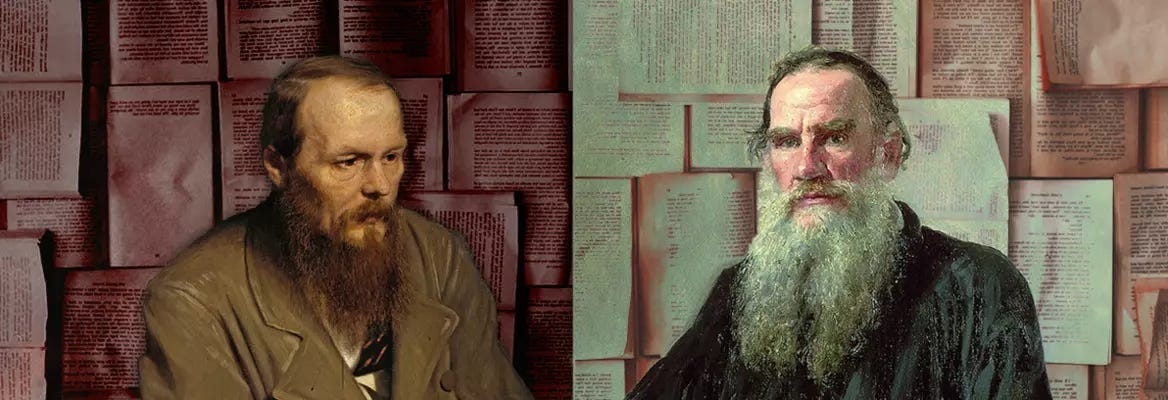
And so it is with many of the great books. How valuable is knowledge for its own sake, independent of any application to society? See Glass Bead Game or Stoner. What are the ethics of being caught in a loveless marriage? See Anna Karenina. Is an anarchist society actually tenable? The Dispossessed. The problem of evil? Brothers K. Are creators responsible for all consequences of their creations? Frankenstein. Moral luck? Middlemarch. Ethics of Fanaticism? Moby Dick. The absurd? The Trial.
Again, I’m not trying to disparage all thought experiments. There are some useful ones. One I like is the Ship of Theseus: If you replace every plank of a ship, is it the same ship? (My answer is yes. The ship is the abstraction, not the physical object.)
What makes the Ship of Theseus a good thought experiment? First, it’s realistic. Or, rather, it’s representative of real situations. We’ve all had our cars or bikes break and get new parts. We can easily ask the same question of them. Second, the details are easily varied without the essence of the question being lost. Replace the ship with a computer? Sure, who cares. The object can be nearly anything, and other details such as the time and location are irrelevant.
But this is not a general theory. Is there something like Karl Popper’s theory of falsifiability but for thought experiments? A demarcation criterion which separates the wheat from the chaff?
I don’t know. For now, it’s enough to notice that as the thought experiment becomes more elaborate, the more the details matter. And at some point, the details matter enough such that, without them, the situation is useless to consider. And that’s when you write a book.
Some really good points here — especially the one about abstract, “pure” constructs having infinite degrees of freedom, to the point of being useless.
It makes me wonder whether a “thought experiment” is almost a contradiction in terms. And if literary fiction is a better thinking device than a thought experiment, then perhaps history is even better still, given that those situations actually happened and we’ve seen their consequences unfold.
This is also a fun article on a related topic: https://substack.com/@markmanson/note/p-194183403?r=g8t8f&utm_medium=ios&utm_source=notes-share-action
Yes - I have always loved fiction over non-fiction for this reason. You could opt to read some paper about moral dilemmas and choosing the many over the one, but fails to torture you in the way C&P does. Thus fails to truly have us face the dilemma.