

I’ve been using anki to learn and remember new things for several years now. It turns out all the hype about spaced repetition was annoyingly correct. Anki is by far the best way of reliably memorizing new information that I’ve ever tried (guys, it’s not even close.)
For those of you who don’t consume Andy Matuschak‘s content like he’s some sort of productivity demigod, anki cards look like this:
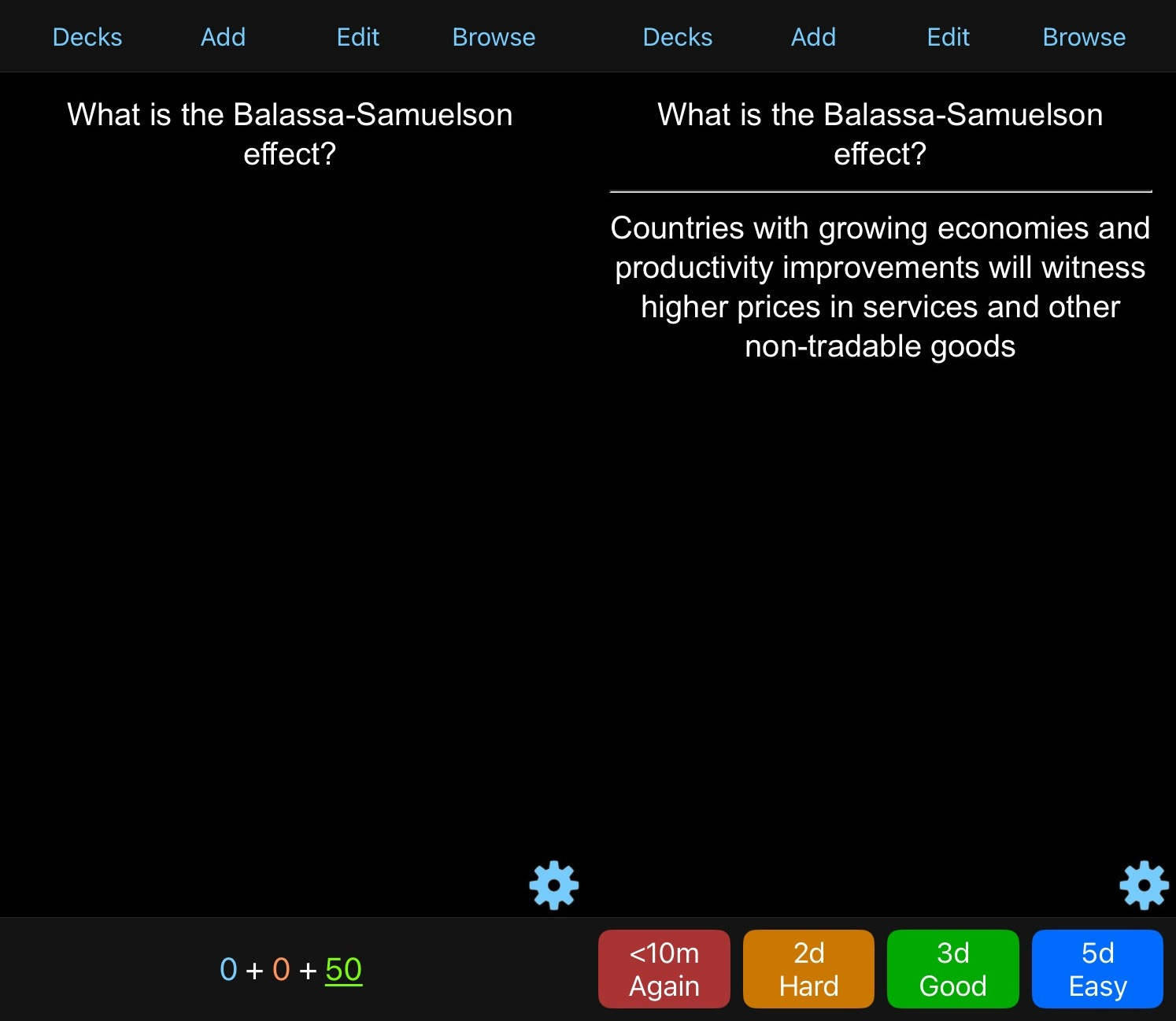
They are digital flashcards that are shown to you at a cadence defined by spaced repetition, which is simply the idea that you should review information at increasing (geometrically spaced) intervals to best remember it. To fight the “forgetting curve,” you need to review new information more frequently after just learning it, and less frequently as time goes on.
One unanticipated consequence of using anki is that I’ve become more interested in more things. While anki is typically recommended as a technology that lets you memorize what you’re already interested in, I’ve found that memorizing brute facts has actually increased the surface area of my interests.
I was, sadly, never good at history. I had a second-order desire to be the kind of person who knew a lot of history, but my first-order preferences would always betray me.
But I bootstrapped an interest in history by learning some basic facts. Just knowing the dates and dynasties of the Delhi Sultanate made me more interested in early India. And then I got interested in how the last dynasty gave way to the Mughal empire, which in turn led to an interest in the East India Company. And now, all of a sudden, I can read William Dalrymple’s The Anarchy at an almost-not-embarrassing pace.
We have theories of learning that partially explain what’s going on here, all of which are along the lines of “knowledge begets knowledge.” It’s easier, obviously, to learn new things when you have the relevant background. You need something to be able to hang your hat on, so-to-speak. You need to be able to relate new things to old things.
But while this explains why it’s easier to learn about the Mughal Empire after I know about what led to its founding, it doesn’t explain why it became more interesting. Why was it fun all of a sudden?
Because we enjoy things that are challenging, but not too challenging. If I’m presented with information and have no context then I’ll fall behind and lose all interest. This is why so many courses feel miserable. If you’re not keeping up with the readings, then you have no idea what’s going on and being in class is a waste of time. Likewise if things are too easy. Nobody does the same crossword over and over again.
But when things are challenging yet achievable, we love it. In fact, these are the kinds of tasks that get us into flow state. And learning, even just learning “basic facts,” involves puzzle solving. You’re constantly asking, “does this make sense?”, “does this accord with everything else I know?”, “if this is true, what else has to be true?”.
Once you lay a foundation, filling in the gaps is fun. And then everything on the periphery of what you’re learning becomes that much more interesting. And before you know it, your anki deck contains a disturbing amount of information on the history of the Indian subcontinent.
Regarding the topic of the article, your insight on anki fostering new interests is spot-on, though I've also found initial interest significanly amplifies learning outcomes.
So you only use Anki to memorize facts? What about like a way of explaining a concept that you really like?