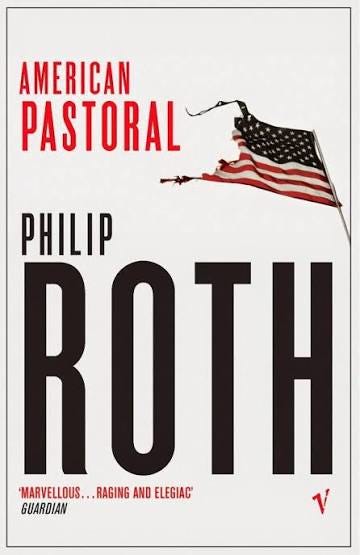
Book club discussion here (now with transcripts!). Spoilers of both American Pastoral and Crime and Punishment below.
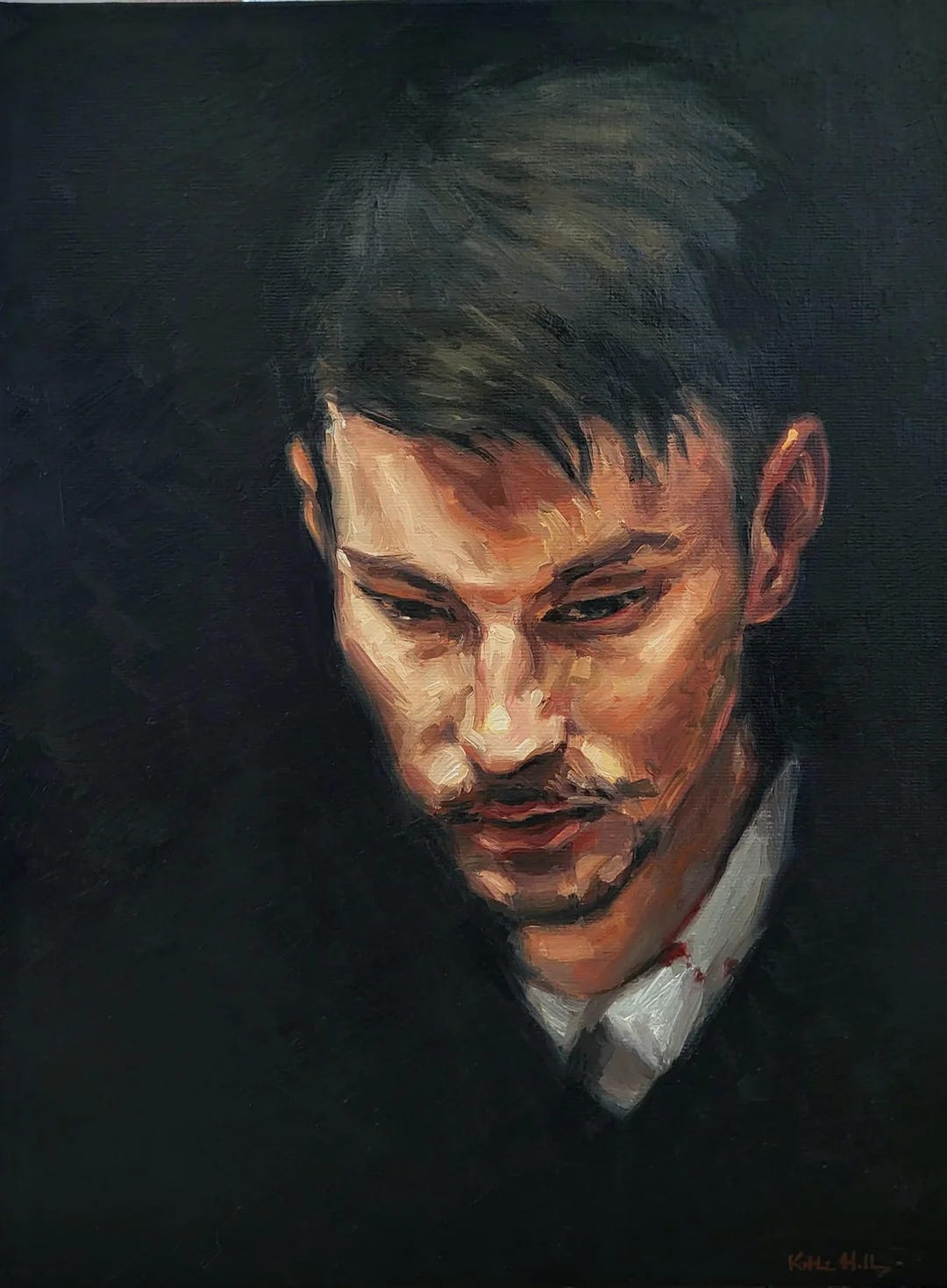
Dostoevsky’s Crime and Punishment follows Rodion Raskolnikov into psychological hell. In the grip of some bad ideas, and through some mix of idealism and selfishness, Raskolnikov decides to kill and rob the old pawnbroker Alyona Ivanovna. He and the world are much better off with the money than she is, after all.
Raskolnikov bludgeons Alyona with the blunt side of a small axe, and then kills her half-sister Lizaveta when she comes home unexpectedly. This scene occurs less than 100 pages into the book, and the reader spends the (many) remaining pages inside Raskolnikov’s head as he deals with its consequences. It’s not a pleasant experience. We become trapped inside a fever of regret and shame, watching him lose his grip on reality and fail over and over again to justify his actions to himself.
American Pastoral by Philip Roth is like the dark matter version of C&P. The plots are driven by similar events, both centred around violent crimes and their subsequent fallout. But while Dostoevsky forces you to become intimately familiar with the details, Roth refuses to let you anywhere near them. Dostoevsky makes you experience the crime first hand, including its motivation, botched execution, and brutal psychological residue. Roth refuses to let you in. You don’t experience anything first hand. You don’t even experience anything second hand.
AP revolves around Meredith “Merry” Levov, a well-off young woman with a loving family who gets embroiled in leftist politics and commits an act of domestic terrorism. It’s 1968, and to protest against the Vietnam War she blows up a post office and kills an innocent man.
Why did Merry do this? Was she truly committed to her political ideals, or was she pressured into it by friends? Was it her idea? Was she elated afterwards? Did she regret it? Did she mean to kill?
We don’t know. We never read anything from Merry’s perspective. We know the general shape of the ideas that influenced her—a radical, anti-war, anti-capitalist ideology. But we know nothing of her specific thoughts; we barely even have access to her as a character. In fact, there are only a handful of scenes in the book where we experience her personality. We briefly witness some of her childhood, which is when we discover that she grew up with a stutter. And we visit her once post-bombing, finding her in a filthy abandoned building, having inexplicably converted to Jainism and refusing to shower because it amounts to a genocide of all the microorganisms on her skin.
The person we become the most familiar with is Merry’s father, Seymour (“the Swede”) Levov. Up until the bombing, the Swede had the kind of life that’s only possible in a novel. Tall, blond, and good looking, he’s the star athlete at his school but inspires little envy. Women want to be with him, men want to be him. The Swede is a third-generation Jewish immigrant beloved by the local Jewish community because he represents the pinnacle of successful assimilation. The Jewish all-American sports star, beating the Americans at what Americans care most about. In the ultimate caricature of the American Dream, the Swede even marries Miss New Jersey.
Nothing is the same after the bombing, of course. The Swede spends most of his time ruminating on Merry’s childhood, trying to isolate the cause of her radicalisation. He castigates himself for every moment of impatience, as if convinced the cause of her anger can be traced to one instance of imperfect parenting. Maybe if Merry hadn’t been asked to finish her vegetables she wouldn’t have lit the fuse.
The Swede dwells on a kiss that he gave Merry when she was young. She asked to be kissed “like you kiss mom” and he hesitatingly, partially obliges, kissing her lips for perhaps a moment too long. His mind is so desperate for answers that it begins to seem plausible to him that there’s a direct line from lip contact to blowing up post offices.
But even though we’re told about some of the Swede’s inner turmoil, he mostly remains a mystery. We only find out near the end, for instance, that the Swede and his wife both had affairs.
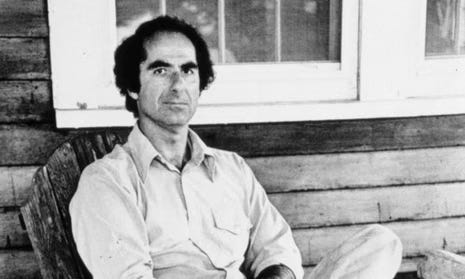
But more substantively, the novel’s framing device ensures that we’re never confident in what we’re reading about the Swede. AP is narrated by Nathan Zuckerman, Roth’s common fictional alter ego. Zuckerman went to high school with the Swede but barely ever spoke to him, being several years his junior and not in the same league coolness-wise. Instead, he was friends with the Swede’s younger brother Jerry and stuck to admiring the Swede from a distance.
At Zuckerman’s 50th high school reunion he learns that the Swede died from cancer and learns about Merry. He begins to recreate the Swede’s life story for himself, filling in the details from scraps of information.
All this means we’re many layers removed from the book’s central tragedy. One result is that the novel highlights the sociological consequences of violence more than the psychological consequences. We don’t know what’s going on in Merry’s mind, but we see from afar how it tore apart her family and community.
But the more haunting result is to remind you how difficult it is to ever truly know someone. Reading AP is uncomfortable. You’re never quite sure how much to trust the words on the page. You can get sucked into thinking that you know the Swede, only to be swiftly reminded that you’re reading Zuckerman’s account. Roth has this in common with certain post-modern authors like David Foster Wallace or Don DeLillo, who want to force you to reckon with the fact that you’re never really inside someone else’s head. You never truly understand them. And there’s always the possibility that they turn around and shock you.
Overall, I find AP more chilling than C&P. In the latter you can put yourself in Raskolnikov’s shoes. Perhaps we’re not all capable of killing someone with an axe (though I have my reservations about this), but we’re all capable of doing things that we’re later ashamed of. And the ideas that drove Raskolnikov to kill Alyona are recognizable: How many times have you reasoned yourself into something because “it’s for the best”? Raskolnikov is an extreme version of a familiar feeling.
But Roth comes at violence orthogonally. It’s horrifying to not know why someone did something. Nathan doesn’t get closure. The Swede doesn’t get closure. And neither do we. We don’t even know what parts of the story are real. All we know is the reality of death and terror, and that’s all we’ll ever get.